
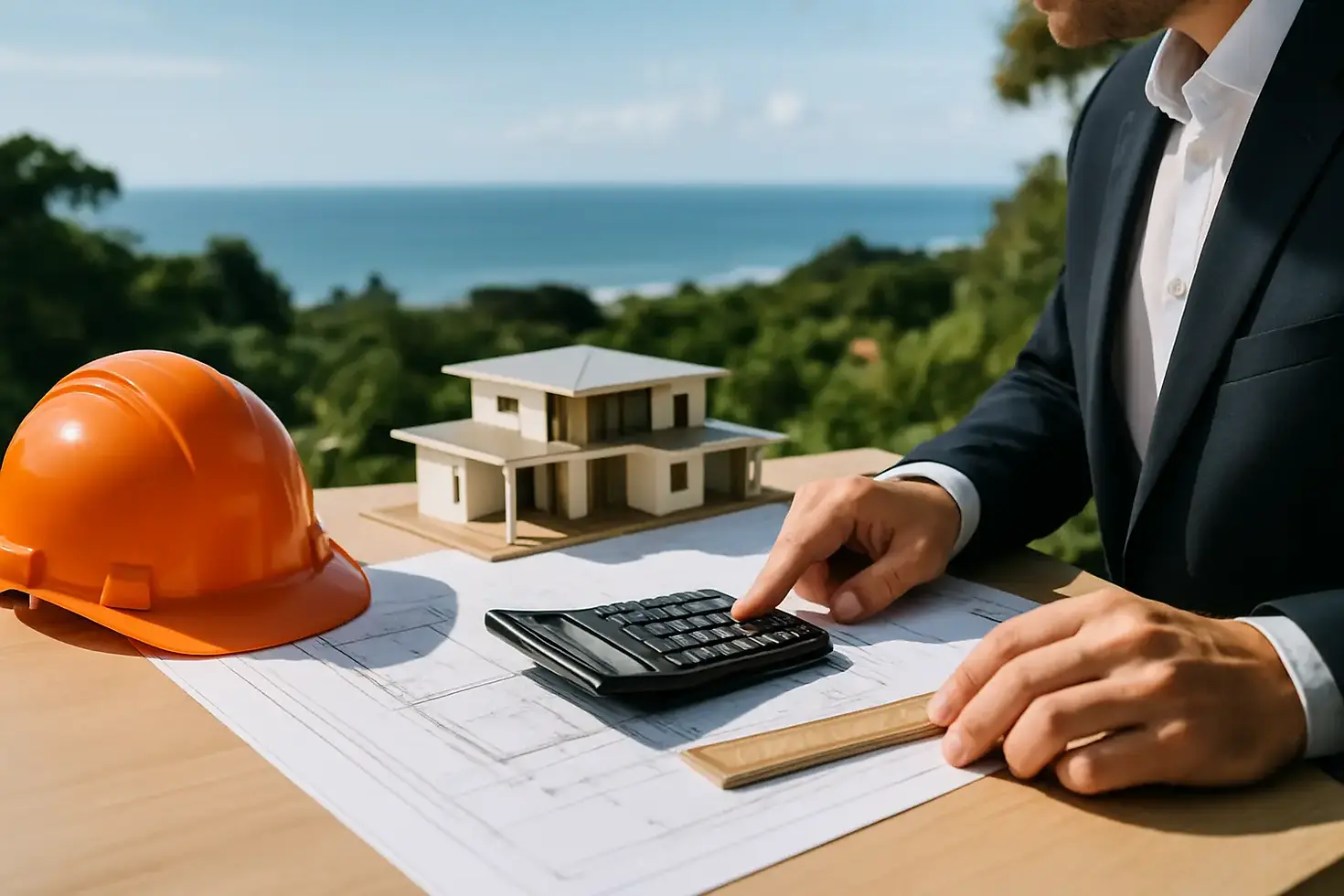
What It Costs to Build in Costa Rica in 2026
- elitebuildinggroup
- Mar 6
- 7 min read

You can usually tell within five minutes whether someone got an honest build quote in Costa Rica or a number designed to win the job. The “too good to be true” bids look clean on paper, then grow legs the moment permitting starts, materials change, or the rainy season shows up.
If you are planning a custom home from the US or Canada, the real question is not just the cost to build a house in Costa Rica. It is what that number includes, what it quietly excludes, and how you keep your budget tied to verified progress when you are not on-site.
Cost to build a house in Costa Rica: realistic ranges
Costa Rica does not have one universal price per square foot. Costs shift by region, access, soils, design complexity, and the level of finish you expect. With that said, most clients building a modern, well-executed home land in one of three broad bands.
For a straightforward, well-built home with practical finishes and minimal structural complexity, a common planning range is roughly $140 to $200 per square foot. For a higher-end custom home with better glazing, more detailed architecture, upgraded kitchens and baths, and stronger project oversight, it often falls around $200 to $300 per square foot. For true luxury - large spans, premium imported finishes, custom millwork, complex pools, extensive outdoor living, smart home systems, and higher design density - $300+ per square foot is a realistic starting point.
Those numbers assume professional management, compliant permitting, and a build quality that holds value. If you receive a quote far below those ranges for a modern home, treat it as a warning to investigate scope, specs, and payment controls.
Why the same house can cost dramatically different amounts
The biggest cost swings in Costa Rica rarely come from one line item. They come from conditions that make labor slower, logistics harder, and mistakes more expensive.
Location is the obvious one. Coastal zones often bring humidity, corrosion exposure, and a need for better window and hardware packages. Mountain sites can mean steep access roads, retaining walls, and more complex foundations. Remote areas add transport costs and reduce competition for skilled trades.
Site conditions do the quiet damage. A flat lot with good soils and easy utility connections builds differently than a sloped parcel that needs engineered walls, drainage solutions, and long utility runs. If you do not have a proper site evaluation early, “foundation” and “site works” are where budgets get surprised.
Design also matters more than people expect. A simple rectangle with a clean roofline is efficient. A home with many roof breaks, cantilevers, tall glass walls, and split-level transitions is slower to build and demands tighter supervision. Square footage is only part of the story - complexity is the multiplier.
The budget categories you should expect (and demand)
A credible budget does not hide the hard parts in vague language. You want line items that reflect how the project is actually delivered in Costa Rica, especially when you are building from abroad.
Pre-construction and design
Plan for architecture, engineering, surveys, and pre-construction work that includes realistic specifications. This is where you prevent the “cheap bid” trap. If drawings are incomplete or specs are generic, contractors are forced to guess - and guesses turn into change orders.
Also plan for early due diligence on the lot: topography, soil considerations, access, water availability, and utility strategy. Spending upfront to reduce unknowns is one of the most reliable ways to protect the final number.
Permits and compliance
Permitting costs vary by municipality and project type. What matters more than the fee is the process control. A permit timeline that drifts by months can inflate carrying costs, create rework, and push construction deeper into peak rain.
For non-resident owners, permitting is also a risk point for miscommunication. You want a team that can coordinate requirements, submit correctly, and keep you updated in plain English without asking you to chase offices or translate documents.
Site work and foundations
This category is where Costa Rica’s “it depends” becomes real. Excavation, retaining, compaction, drainage, and foundation engineering can be modest on an easy lot or substantial on a hillside or coastal parcel.
A responsible budget separates site work from vertical construction, so you can see exactly what the land is demanding. When site work is lumped into a single number, overruns have room to hide.
Structure, envelope, and windows
Concrete and masonry are common, but your structural choices should match the design, climate, and long-term maintenance expectations. The envelope is not just a construction term - it is your comfort, your energy use, and your mold prevention.
Windows and doors deserve special attention. Many cost overruns happen when clients assume “nice glass” is included and later discover the quote was based on basic aluminum frames. In coastal areas, hardware and finishes need to resist corrosion, and that costs more for a reason.
Mechanical, electrical, and plumbing (MEP)
MEP can be underestimated in Costa Rica because early quotes sometimes assume minimal lighting plans, limited exterior power, or basic water heating. Modern homes with strong air conditioning design, backup power, water filtration, irrigation, and smart systems should budget accordingly.
If rental performance matters, reliable hot water, quiet AC, and good lighting are not optional. They are what guests notice, and what you end up paying to fix later if they are under-scoped.
Interior finishes and fixed elements
Kitchens, bathrooms, flooring, and millwork are where luxury budgets separate quickly. A simple cabinet package and a premium custom kitchen can be worlds apart, even if the house size is identical.
The key is to decide early what you care about most. If you want the “wow” factor in the kitchen and primary suite, you can often balance the budget by keeping secondary spaces clean and restrained.
Outdoor living, pools, and landscaping
In Costa Rica, outdoor areas are not an afterthought. They are part of the living space. Pools, decks, outdoor kitchens, and landscaping can add meaningful cost - and they can also be the difference between a home that feels resort-level and one that feels unfinished.
If you are building for lifestyle and resale, the exterior experience is usually one of the highest ROI design choices, but only if it is planned in the main budget instead of added later.
Hidden costs that catch overseas owners
The most frustrating budget surprises are the ones that were predictable but not disclosed.
One is utilities. Extending power to a site, upgrading service, drilling or improving a well, building a cistern, or installing serious filtration can shift totals. Another is access and staging: steep driveways, temporary roads, and material storage add cost in remote areas.
Then there is timing. If a project drifts, you may pay more for security, temporary facilities, re-mobilization of crews, and price changes on materials. This is why schedule control is budget control.
Finally, there is payment risk. Fragmented payments to multiple contractors, paid in advance without verification, is one of the most common ways budgets spiral - and one of the hardest problems to solve after the fact.
How to compare bids without getting burned
If you are evaluating quotes, focus less on the bottom line and more on what is specified, what is excluded, and how payments are governed.
First, make sure bids are based on the same drawings and finish schedule. If one contractor is pricing “allowances” and another is pricing specific products and assemblies, you are not comparing apples to apples.
Second, demand clarity on exclusions. If windows, cabinetry, appliances, AC, landscaping, driveway, or retaining walls are excluded or treated as allowances, you need to know the assumed level. A low allowance is not savings. It is deferred reality.
Third, look at supervision and accountability. Who is coordinating trades? Who is checking quality? Who is confirming quantities and progress before money is released? In overseas construction, the management structure is not overhead. It is protection.
Budget protection: the part most people skip
A stable build budget in Costa Rica is less about finding the cheapest labor and more about controlling the process.
Milestone-based payments tied to verified progress are a major safeguard. When funds are released only after work is completed and confirmed, you reduce the chance of paying for work that is delayed, incomplete, or poorly executed. This matters even more when you are not physically present to inspect.
Consistent reporting is another safeguard. Clear weekly updates with photos, schedule status, open decisions, and budget tracking are not a “nice to have.” They prevent small issues from becoming expensive ones.
This is also where a full-service operator can change the experience. Elite Building Group, for example, pairs project leadership with licensed, milestone-based escrow services so payments stay secure and transparent, tied to real progress instead of promises. That structure is designed to keep the build exciting instead of stressful.
A practical way to estimate your own project
To get to a dependable planning number, start with three decisions: your target quality level, your location and site difficulty, and how complete your plans and specs will be before pricing.
If you want a modern 3,000 square foot home with high-end finishes in a coastal market, budgeting $200 to $350 per square foot is usually more honest than chasing a low quote. If your design is simpler, your site is easy, and you are comfortable with a more restrained finish package, you can plan closer to the lower end of the ranges.
Then add realistic soft costs: design and engineering, permits, and professional project management. Add outdoor scope if you care about lifestyle and rental appeal. Finally, include a contingency sized to your risk profile. A well-defined project with strong oversight can often carry a smaller contingency than a loosely defined project with many allowances and owner-supplied items.
The goal is not to guess perfectly. The goal is to build a budget that reflects how projects actually behave on the ground, with enough structure that surprises are managed, not multiplied.
If you want one closing principle to hold onto, make it this: the best budget is the one that is specific, supervised, and paid out in verified stages - because in Costa Rica, control is what keeps your dream home fun to build.


Comments